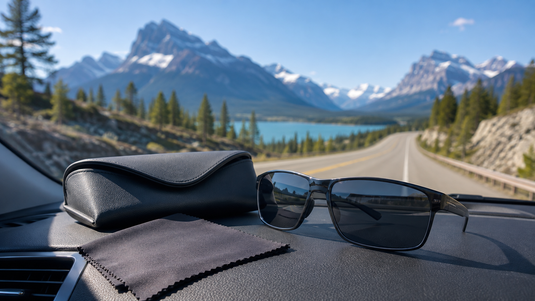
Good driving sunglasses should reduce uncomfortable brightness while preserving a clear view of traffic signals, road markings and hazards. The darkest lens is not automatically the safest. For daytime driving, prioritize verified UV protection, an appropriate tint, a comfortable fit and lenses that do not distort your view.
UV protection and darkness are different
A dark lens does not prove that it blocks ultraviolet radiation. Look for clear information about UVA and UVB protection. Health Canada explains that general-purpose sunglasses are suitable for driving in bright conditions, while special-purpose very dark sunglasses are not recommended for driving. Read the current Health Canada sunglasses guidance.
Why polarization can help
Polarized lenses reduce glare reflected from flat surfaces such as wet roads, snow and vehicle hoods. That can improve comfort in bright daytime conditions. However, polarization may make some dashboard or head-up displays harder to read at certain angles, so test visibility before relying on a pair.
Choosing a useful lens colour
- Grey: reduces brightness with relatively neutral colour perception.
- Brown or amber: can increase perceived contrast and may feel comfortable in variable daylight.
- Green: offers balanced contrast and colour perception for many wearers.
- Yellow or very light tints: may feel brighter in low light but are not a substitute for adequate night vision or a correct prescription.
Lens performance matters more than fashion colour. Ensure the tint does not make traffic signals difficult to distinguish.
Avoid very dark lenses at night
Sunglasses reduce the amount of visible light reaching the eyes and should not be used for night driving. Professional guidance also warns that strongly tinted filters are unsuitable in twilight or at night. See the College of Optometrists guidance on tints and driving. If night glare is a problem, have your prescription, windscreen and eye health checked.
Frame fit and coverage
A secure frame should stay in place when you check mirrors and blind spots. Wider lenses and comfortable side coverage can help reduce stray light, but oversized frames must not interfere with peripheral vision. Keep lenses clean; haze, scratches and fingerprints scatter light and can worsen glare.
Driving sunglasses checklist
- Verified UVA and UVB protection
- Tint intended for daytime road use
- Clear view of dashboard and traffic signals
- Accurate prescription if correction is required
- Secure fit with unobstructed peripheral vision
- Clean, undamaged lenses
Compare styles in our men’s sunglasses and women’s sunglasses collections, then verify the specifications of the individual pair.
Frequently asked questions
Are polarized sunglasses always best for driving?
They are useful for reflected glare, but check that you can still read your vehicle displays clearly.
Can I drive in category 4 or very dark sunglasses?
Very dark special-purpose lenses are not intended for road use.
Do I need prescription sunglasses?
If your licence or eye-care professional requires vision correction for driving, the sunglasses must provide the appropriate correction.
This guide provides general information and does not replace advice from an optometrist or other qualified eye-care professional.