The right-size glasses should feel secure without pinching, sit level and keep your eyes comfortably positioned within the lenses. Labels such as small, medium and large are only rough guides. A better approach is to combine printed frame measurements with bridge design, total width, lens depth and your experience with a pair that already fits.
Understand the three printed numbers
Most frames display a sequence such as lens width, bridge width and temple length, all in millimetres. Lens width measures one lens opening horizontally. Bridge width describes the space between the lenses. Temple length runs along the arms toward the tips. These figures help compare frames, but they do not capture every design difference.
Measure a comfortable existing pair
- Choose glasses that stay in place for several hours without pressure.
- Record the numbers printed inside a temple.
- Measure the total outside width of the frame front.
- Measure lens height at the deepest point.
- Note whether the bridge is moulded or uses adjustable nose pads.
- Record the frame material and shape.
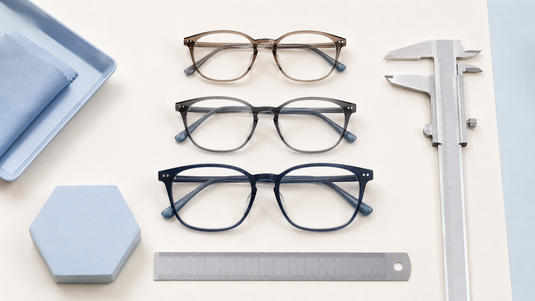
Use a millimetre ruler on a flat surface and measure twice. This creates a practical size range for online comparison.
Check total frame width
A frame that is too narrow can squeeze the temples and cause the arms to bow outward. A frame that is too wide may slide, sit unevenly or place the hinges beyond the sides of the face. Total width is often more useful than lens width alone because end pieces and hinges vary between designs.
Evaluate the bridge
The bridge should distribute weight comfortably and hold the frame in a stable position. A low, high, narrow or wide bridge can change fit even when the printed bridge number matches. Adjustable nose pads offer more flexibility; moulded bridges depend more heavily on matching the wearer’s shape.
Check temple length and lens depth
Temples should reach behind the ears without excessive pressure or a large loose gap. Lens depth affects appearance, cheek clearance and suitability for some multifocal designs. Progressive lenses generally need appropriate vertical space and professional fitting measurements.
Signs of a good fit
- The frame stays level during normal movement.
- The bridge feels secure without pinching.
- The temples are comfortable at the sides and behind the ears.
- Eyelashes do not touch the lenses.
- The lower rims do not lift significantly when smiling.
- Your pupils sit in a sensible area of each lens opening.
Shape affects perceived size
Round, square, rectangle, oval and cat-eye glasses can feel different even with similar printed numbers. Thick rims, deep lenses and pronounced end pieces change both fit and visual scale.
Frequently asked questions
Are glasses sizes standardized?
The measurement method is broadly consistent, but two frames with identical numbers can fit differently.
How much size difference is acceptable?
That depends on the bridge, total width and frame construction. Use a comfortable pair as the closest reference.
Can an optician make any frame fit?
No. Adjustment can refine a suitable frame but cannot fully correct a fundamentally wrong size or bridge design.
This article provides general eyewear-care information. Follow the instructions supplied with your lenses and consult an optician when fit, damage or vision is uncertain.