An eyeglass prescription can look like a table of abbreviations, plus and minus signs, and decimal numbers. Each entry has a specific role. Understanding the layout helps you copy it accurately when ordering, but it does not allow you to diagnose vision problems or change the prescribed values.
Right eye and left eye
OD traditionally identifies the right eye and OS the left eye. Some prescriptions use R and L instead. OU means both eyes. Always read the row label carefully; entering the eyes in reverse will produce incorrect lenses.
SPH: sphere
Sphere is the main lens power, measured in dioptres. A minus sign is commonly used for myopia (short-sightedness), while a plus sign is commonly used for hyperopia (long-sightedness). The sign is essential: +2.00 and −2.00 are not interchangeable. “Plano,” “PL” or 0.00 indicates no spherical power.
CYL and AXIS: astigmatism correction
CYL is the cylinder power used to correct astigmatism. AXIS describes the orientation of that cylinder, written from 1 to 180 degrees. An axis normally accompanies a cylinder value; it is not a lens power on its own. Different offices may write cylinder in plus or minus notation, so copy the prescription exactly and do not convert it yourself.
ADD: near addition
ADD is extra plus power used for near viewing in multifocal prescriptions. It may be used for bifocal or progressive glasses. Accurate fitting measurements are especially important because the wearer uses different areas of the lens for different distances.
Prism and base
Prism may be prescribed to help with certain binocular vision or eye-alignment needs. The prescription also states the base direction. Prism orders require careful interpretation and fitting; contact the optical provider if any part is unclear.
PD is usually separate
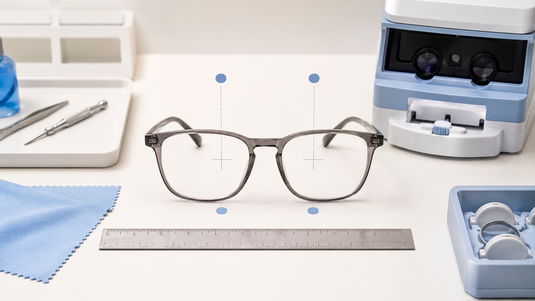
Pupillary distance is a measurement used to centre the lenses; it is not a prescription power. It may appear as one binocular number or separate right and left values. Some prescriptions do not list it, so request the measurement from the provider who took it or follow a professionally supported measurement method.
Before ordering glasses online
- Confirm the document is an eyeglass prescription.
- Check the patient name and examination date.
- Copy every plus sign, minus sign and decimal exactly.
- Do not confuse SPH, CYL, AXIS and ADD.
- Enter right and left eyes in the correct rows.
- Include prism only when it appears on the prescription.
- Ask for clarification when handwriting or abbreviations are uncertain.
The American Academy of Ophthalmology’s prescription guide provides a useful clinical overview. Once your details are ready, explore all glasses by shape and colour.
Frequently asked questions
Can I change the sign if the online form looks different?
No. Stop and contact the retailer or prescriber. Never guess or convert the values yourself.
Is an eyeglass prescription the same as a contact lens prescription?
No. Contact lens prescriptions include different information and cannot be used as eyeglass prescriptions.
What if one box is blank?
A blank may be intentional, but confirm with the prescriber or optical provider rather than entering zero automatically.
This guide provides general information and does not replace advice from an optometrist or other qualified eye-care professional.