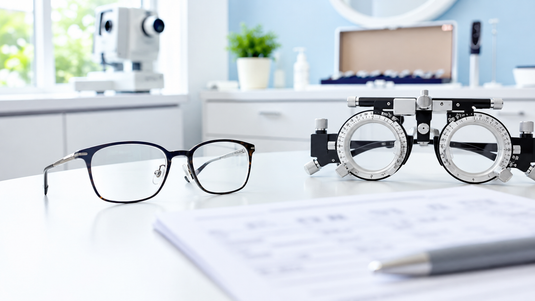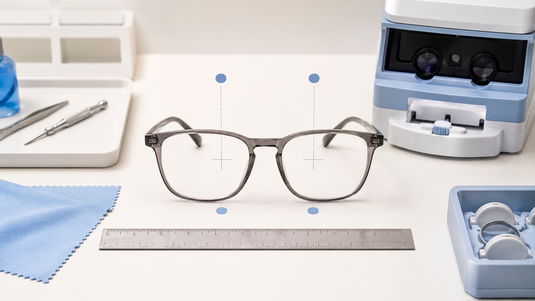
Pupillary distance, usually shortened to PD, is the distance between the centres of the pupils measured in millimetres. Lens makers use it to place the optical centre of each lens in the correct horizontal position. PD does not describe how strong your prescription is, but it is an important fitting measurement for prescription glasses.
Single PD and dual PD
A single or binocular PD is one total measurement from the centre of one pupil to the other. A dual or monocular PD gives two measurements: from the centre of the nose bridge to each pupil. The two sides are not always identical, so dual PD can provide more specific centration information.
Distance PD and near PD
Distance PD is measured while looking at a far target. Near PD is smaller because the eyes turn inward when focusing close up. Use the measurement requested for the lens and task. Do not subtract a guessed amount from a distance PD to create a near PD.
Why PD accuracy matters
Prescription lenses are designed around optical reference points. If those points do not align appropriately with the wearer’s eyes, vision may feel less comfortable. The effect can be more noticeable with stronger prescriptions, prism, multifocal designs or large frames. PD is only one part of fitting: progressive lenses may also require an accurate vertical fitting height.
The most reliable measurement options
- Ask your eye-care or optical provider. If PD was measured during fitting, request the recorded value.
- Have it measured professionally. An optician can use a pupillometer or millimetre ruler while controlling the viewing target and alignment.
- Use a retailer’s guided method. If self-measurement is offered, follow its instructions exactly and repeat the result several times.
Common self-measurement mistakes
- Looking at the ruler instead of the specified distant target
- Holding the ruler at an angle
- Moving the head between readings
- Mixing centimetres and millimetres
- Confusing single PD with two monocular values
- Measuring from the inner or outer iris edge instead of pupil centres
- Using a phone image without the required scale reference
How to record PD for an online order
Keep the original units in millimetres. Label right and left clearly when you have dual PD. If the order form accepts only one number but you were given two, contact the retailer rather than averaging them without instruction. Store the measurement with your prescription, while remembering that PD does not replace the prescription itself.
PD and frame choice
Frame width and lens size influence where the optical centres need to be positioned. Very wide frames may require more lens decentration, which can affect edge thickness and appearance in some prescriptions. Choose frames close to a comfortable size and ask for advice when your prescription is strong or includes prism. Browse all glasses after confirming both PD and frame measurements.
Frequently asked questions
Is PD written on every prescription?
Not always. It may be recorded separately as a dispensing measurement.
Does PD change?
Adult distance PD is generally stable, but measurement technique and the required viewing distance can change the recorded value. Children’s measurements can change as they grow.
Can I use an old pair of glasses to find PD?
An optical professional can locate lens optical centres, but that does not necessarily equal your anatomical PD or confirm that the old glasses were centred correctly.
This guide provides general information and does not replace advice from an optometrist or other qualified eye-care professional.