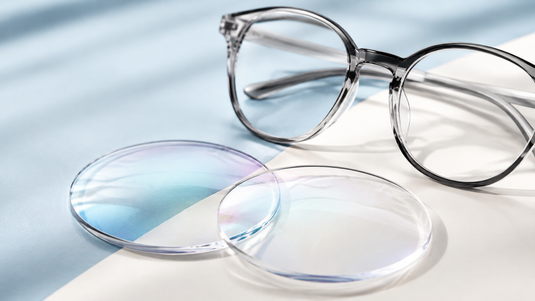
The frame is the visible part of your glasses, but the lenses do the optical work. The right lens design depends on your prescription, viewing distances, daily activities and comfort preferences. This guide explains common eyeglass lens types in plain language so you can have a more informed conversation with your optometrist or optical provider.
Single-vision lenses
Single-vision lenses have one prescription power across the lens. They may be prescribed for distance, near work or a specific intermediate task such as computer use. They are often the simplest choice when correction is needed at only one main viewing distance.
Bifocal lenses
Bifocals combine two viewing zones: usually distance above and near below. A visible line separates them. The clear division can make each zone easy to locate, although the image may seem to jump when the eyes cross the line. Explore our bifocal glasses collection if your prescription includes a near addition.
Progressive lenses
Progressives provide distance, intermediate and near correction without a visible segment line. Because power changes gradually, accurate PD, fitting height and frame selection are especially important. The usable viewing zones and adaptation experience vary by design. See progressive glasses and ask an eye-care professional whether they suit your prescription and routine.
Lens materials and index
Lens material influences thickness, weight, impact resistance and optical characteristics. Higher-index materials can produce thinner lenses for some stronger prescriptions, but “highest index” is not automatically best for every order. Frame size, lens shape, prescription, centration and budget all influence the finished result.
Common lens treatments
- Anti-reflective coating: reduces reflections from lens surfaces and can improve lens appearance and visual comfort.
- Scratch-resistant treatment: helps with everyday durability, though no lens is scratch-proof.
- UV protection: helps reduce exposure to ultraviolet radiation. For sunglasses, verify the stated UVA and UVB protection.
- Photochromic lenses: darken in response to UV exposure and become lighter indoors; performance inside a vehicle can differ because windshields block much UV.
- Polarization: reduces reflected glare and is commonly useful for driving, water and snow activities.
- Blue-light filtering: changes how some wavelengths are transmitted. Comfort benefits vary, so it should not replace breaks, good lighting or an appropriate prescription.
How to choose
Start with the viewing problem you need to solve. List how much time you spend driving, reading, working at a screen and moving between distances. Then consider lens thickness, weight, reflections and care. If you are curious about screen-oriented options, browse blue-light glasses, while remembering that persistent digital eye discomfort deserves a complete assessment.
Quick lens checklist
- Is the prescription current and complete?
- Which distances must the glasses cover?
- Does the frame provide enough lens depth for the chosen design?
- Which coatings solve a specific need?
- Are care, warranty and remake terms clear?
Frequently asked questions
Are progressive and bifocal lenses the same?
No. Both can provide distance and near correction, but bifocals have a defined near segment while progressives change power gradually.
Are high-index lenses always thinner?
They can reduce thickness in suitable prescriptions, but frame dimensions, shape and lens positioning also matter.
Do coatings last forever?
No. Lifespan depends on coating quality, heat exposure, cleaning habits and daily wear.
This guide provides general information and does not replace advice from an optometrist or other qualified eye-care professional.